Rebecca, sadly no stranger to adversity, was diagnosed with breast cancer in 2021 but took solace in her previously hidden talent for poetry
Rebecca, a busy young mother of two who had dealt with physical disability since childhood, now had to contend with a breast cancer diagnosis and later metastatic breast cancer. A quote from Rebecca’s blog: ‘I started talking about hydrocephalus and my disability when diagnosed with incurable breast cancer. Suddenly, crutches weren’t the problem!’
Read more about Rebecca’s story below
I was diagnosed with primary breast cancer in June 2021, when my children were just one and four, with the eldest about to start school. My primary care experience wasn’t good. My GP wasn’t proactive with my initial diagnosis, and I felt written off early, saying it was probably mastitis from earlier breastfeeding. Even though I had a scan which showed three lumps and a lump in my armpit they seemed to dismiss my concerns, saying it wasn’t serious enough. After changing GP, I was eventually diagnosed with primary breast cancer. I initially had six sessions of chemotherapy but had to discontinue as the treatment caused a bad flare up of my asthma, so I didn’t have the last two cycles.
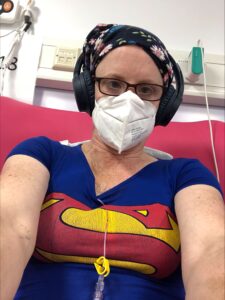 Then I had a mastectomy, followed by a period where the doctors weren’t sure what they were doing with me. They would try one thing and then try another. They said I was at a high risk of recurrence, and they were going to give me one treatment for a year, then it was something else. It kept changing and so it was quite stressful. I then had a bone scan to check I was all clear of cancer – except it hadn’t gone – “it’s spread to your bones” they said. To my spine and hips.
My doctor told me it wasn’t so bad with the cancer being in my bones because it was slow growing and wasn’t aggressive, but also that it couldn’t be cured. So that was obviously a big, big thing. Initially, they thought my breast cancer was HER-2 positive and I had one specific treatment. But after I had a scan and bone biopsy, which was horrific, they said it was ER (oestrogen) positive. Then I was started on the drug ribociclib but had another flare up with my asthma. So, I was switched to palbociclib (Ibrance) which I was on for about four years. Then I had a period with reduced scans and appointments by telephone and a CT scan every three months. After one scan they said they were worried about my liver, gave me an MRI scan and found six tumours in my liver, so I had a biopsy (Aug 2026) and I’m waiting for biopsy results to see whether the cancer is the same type or has changed.
So, another period of waiting – there is a lot of waiting during cancer treatment.
At the time of writing (Sept 2026) Rebecca was waiting for treatment decisions from the doctors, with abemaciclib (a different CDK4/6 targeting drug to ribociclib and palbociclib) an option and the possibility of a clinical trial.
Rebecca’s poetry helped her come to terms with breast cancer
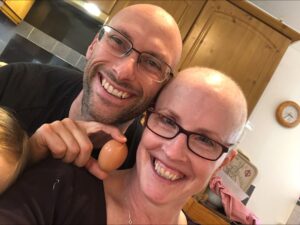 I started writing in the summer after my treatment started, in 2022. I was referred to a wellbeing course which had a lot of crafts, painting and sewing, things I wasn’t very good at. But after they gave us a gratitude journal to write in, I started writing and found I couldn’t stop! I was writing poems all through that summer.
I showed my poems to a friend, and she said I should publish them. So, then I started doing a website, doing a blog. I put my poems on YouTube, and then I had a few things published. More recently, I worked with a poetry tutor to get a collection together and I hope to self-publish in association with the charity Sheldon’s Shooting Stars to get the message out to people, because I’ve certainly found reading other people’s stories very helpful in terms of being able to identify things with my own experience.
Rebecca found the process of writing therapeutic
As I’d grown up with a disability, I had a lot of history and baggage from that, so it was therapeutic to keep writing, to get things out which helped me come to terms with everything that has happened.
I found my experience of having cancer quite different to my experience of being disabled. I feel like there is a stigma attached to being disabled and society’s perception of you is quite negative. At least the narrative around cancer is all quite positive, like you’re a warrior and you’re fighting a battle and everyone’s very sympathetic and it’s like, oh, it could happen to anyone. And a lot of people assume when they see my crutches, that’s because of my cancer, but no, it’s because of something else. But for my breast cancer at least, it’s good that people are very encouraging and sympathetic.
Rebecca on the effect of her cancer treatment on her young children
My children were one and four when I was diagnosed so the younger one didn’t know a time when I wasn’t ill and didn’t have cancer, although during my chemotherapy there was a period where she wouldn’t leave and didn’t want to go to nursery. But later it was fine. For my eldest, I felt guilty after getting cancer, because beforehand she was a confident toddler and my diagnosis gave her a real knock. Because I was undergoing chemo, someone else had to take her to school, and she struggled for years leaving me in the mornings, or when I went out for an appointment, it was really tricky. But it gradually got better and she’s gained more confidence. Being on palbociclib for four years kept things relatively stable, with less disruption to my girls’ lives. I just had to get on with it, do the school runs, even though I might have felt terrible in the mornings, often throwing up. My girls are both very kind, very empathetic children, maybe more than their years, and they’re both very happy and settled despite the challenges. However, I’m worried though about what happens next if I need to change medicine – will there be side effects and more hospital visits which will impact my girls and their routine?
With the diagnosis of secondary breast cancer, I decided to take early retirement from teaching. This means I have more time for the girls and, if I have the energy, to do voluntary work.
Rebecca’s poetry book plans
Rebecca is working with her sister, a graphic designer, on designs and illustrations for her book, with most of the poetry written. The charity Sheldon’s Shooting Stars is supporting Rebecca with the promotion of the book which she aims to have listed on Amazon.